 Where were they? If you're going to position actors on the floor of the theatre, you need to ensure they can be seen from any seat. Craning didn't suffice: there was much I missed.
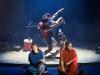
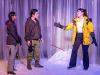
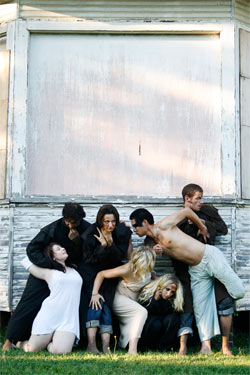
But what a set. Grungy, just like the laneways of Kings Cross, on a Friday night. An apocalyptic urban space; as desolate, if not moreso, than the foreboding central desert. In this space, humanity swarms. And yet, 'absence fills the space between the buildings'. Don't we know it. Here we have four helpless, hapless victims of that awful, incurable disease, the human condition. They're destitute. Perhaps homeless. They certainly have no spiritual home. No peace. Or not for long. They just roll around in the dung, like the rest of us. Roll with the punches. And there are plenty of those. It's like being on the losing side of a prizefight, in this ring. And why do so many days have to be groundhogs? Just when you think you've turned a corner, you find yourself back on the same lonely, familiar road. The horizon, like that on the Nullarbor, stretches forever. You know there's an end, a destination, but you can't see it coming, and you've no idea when you'll arrive. So you just keep on driving. Humdrum. Hum. Drone.
This is the feeling, the aesthetic, director Felicity Nicol has gone for, in ABitOnTheSide's production of Crave, the second from final play by Sarah Kane, at Erskineville's undersung PACT theatre. Set, lighting, sound and costume are craftily synthesised to achieve her dark ends. In these dark arts, plenty of credit must be heaped upon Pia Leong & Evie Meikle, Teegan Lee, Joseph Dutaillis and Lucy Thornett, respectively. I especially like the ragged clothes and dim glow imposed by the angled, staggered row of pseudo-streetlamps; not to mention the simple, but devastating effect of an open stage door, through which light flooded.
Kane's saga is a short one. Born in 1971, the English playwright was done and dusted by 28. She hanged herself. Her struggle with depression can almost be sensed in the forthrightness, chaos and violence of her work. Actors tumble over and into one another; physically and verbally. If you have a clear preference for naturalistic theatre, steer well clear. This isn't everyone's cup of tea. I find, and found, the work challenging, frustrating and, for moments at a time, enthralling. But like the life it portrays, it's a rollercoaster; one big, bad, long, almost unendurable trip.
This, of course, is the irrefutable genius of Kane's work, but it's a hard road to hoe, for actors and audience alike. (These actors, by the way, did a remarkable job: Amanda Stephens-Lee; Richard Hilliar; Rebecca Wood; Maurizio Degliesposti.)
It's the kind of expressionism more readily associated with turn-of-last-century German & Swedish theatre, so at least you know who to blame if it leaves a bitter taste in your mouth: bloody Strindberg, et al.
Director, Nicol, is right: Sarah Kane's theatre is one of fearless extremes; thus, any one who goes there is taking big risks and brave hearts and souls are required. That she, her cast and crew have ventured into such fraught territory is laudable in itself. That they've emerged, relatively unscathed, is little short of miraculous. Kane is an acid-bath, for all concerned, but one well-worthy of putting a toe into. Whether you'll be able to fully immerse yourself, without lesion, is another, highly-individual question. My companions didn't emerge unscathed, and neither did I, but this is down to the demanding work, not the performance or production which, aside from my opening caveat, were extraordinarily impressive; again, all the moreso given the limitations on resources for independent theatre.
One thing that stood out for me were flashes of intense humour, which matched the intensity of the play's other extreme emotional content. Indeed, it almost seems as if Kane was, in fact, not so gently parodying her own propensities, and all notions of existential angst, as bourgeois self-indulgence. Again, Nicol's directorial notes lend insight: 'a beautifully cacophonous poem, that tells the story of four people trapped in an endless cycle of guilt, abuse, depression, desire, rejection, lust, abandonment and death'. The fact they're no Robinson Crusoes is what imbues the work with its power and purpose. These resilient beings, as we all must, keep getting up, after being knocked down, until the final redemptive blast of light rescues them from. Whether Kane truly believed in a religious liberation is anyone's guess. It seems more like dark, cynical mockery to me. Interesting. And the sort of theatre that doesn't leave you after you've left the theatre, but haunts and torments you well beyond its actual duration: far from an epiphany, it's a slow burn.
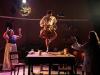
Carolyn Eccles both wrote and directs Lot's Wife. Like Nicol, she's young and 'emerging', with a nonetheless vast exposure to various aspects of theatre. Together they are, effectively, ABitOnTheSide, along with stalwart collaborator, Nicholas Moore. Performances, especially the magical, mischievous one by Emily Watson, as the Girl, but also those of Lara Lightfoot, as the Ghost, Jacob Thomas, as Nathaniel, Julian Wong, as Zachariel, and Lucas Connolly, as the Fisherman were impressive, as again were all the aspects of craft deployed. But, in the end, this was a progressive segue of vignettes; abstracted imagery, inspired, perhaps, by the biblical story, but only in the same, loose way, as The Bible itself is divinely inspired, but not directly given. I can accept Eccles gambit that it's 'a physical retelling', but, even in acknowledging a compelling, fragile beauty and notional references to fairytales, myths and archetypes across cultures (if mostly rooted in wintry European ones), it completely lost me in terms of any kind of narrative or thematic engagement. The audience per se, as with Crave, seemed patient, willing and receptive, but my companions and I could not, even after relatively vigorous discussion, discern any real or imagined meaning. We couldn't even seem to invent it. Aesthetically alluring, but ultimately incapable of delivering its promise, Lot's Wife could and would benefit from greater clarity of purpose. It should either do away with words altogether, or use them to communicate in a linear, as against lateral, or oblique, way. In fact, it doesn't achieve oblique: it's obtuse; accessible only in a visual, sensual way and in that, and that alone, it excels.
All things considered, ABitOnTheSide, however, has prodigious promise and a bright artistic future: Nicol and Eccles have a wealth of experience, talent and skill between them; money in the bank, in theatrical terms. But Eccles writing pencil needs a little sharpening.
ABitOnTheSide presents
CRAVE by Sarah Kane | Directed by Felicity Nicol
and
LOT’S WIFE Written and directed by Carolyn Eccles
Venue: PACT Theatre, Erskineville
Dates: 29th April - 8th May
Time: 8pm (Saturday matinee @ 2pm, Sunday @ 5pm)
Tickets: $25 adult $20 concession
Bookings: http://www.trybooking.com/efc